Telemedicine in Colombia: what changes with Resolution 1644 and how to prepare an IPS
Resolution 1644 of 2026, issued by Colombia's Ministry of Health and Social Protection, is the new telehealth and telemedicine regulation in Colombia and repeals Resolution 2654 of 2019. It was issued on July 31, 2026 and published in the Diario Oficial (Official Gazette) on September 7. It defines four categories of telemedicine, requires platforms that are interoperable with the electronic medical record, sets rules for the use of artificial intelligence and gives providers with accredited telemedicine services a period to adjust.
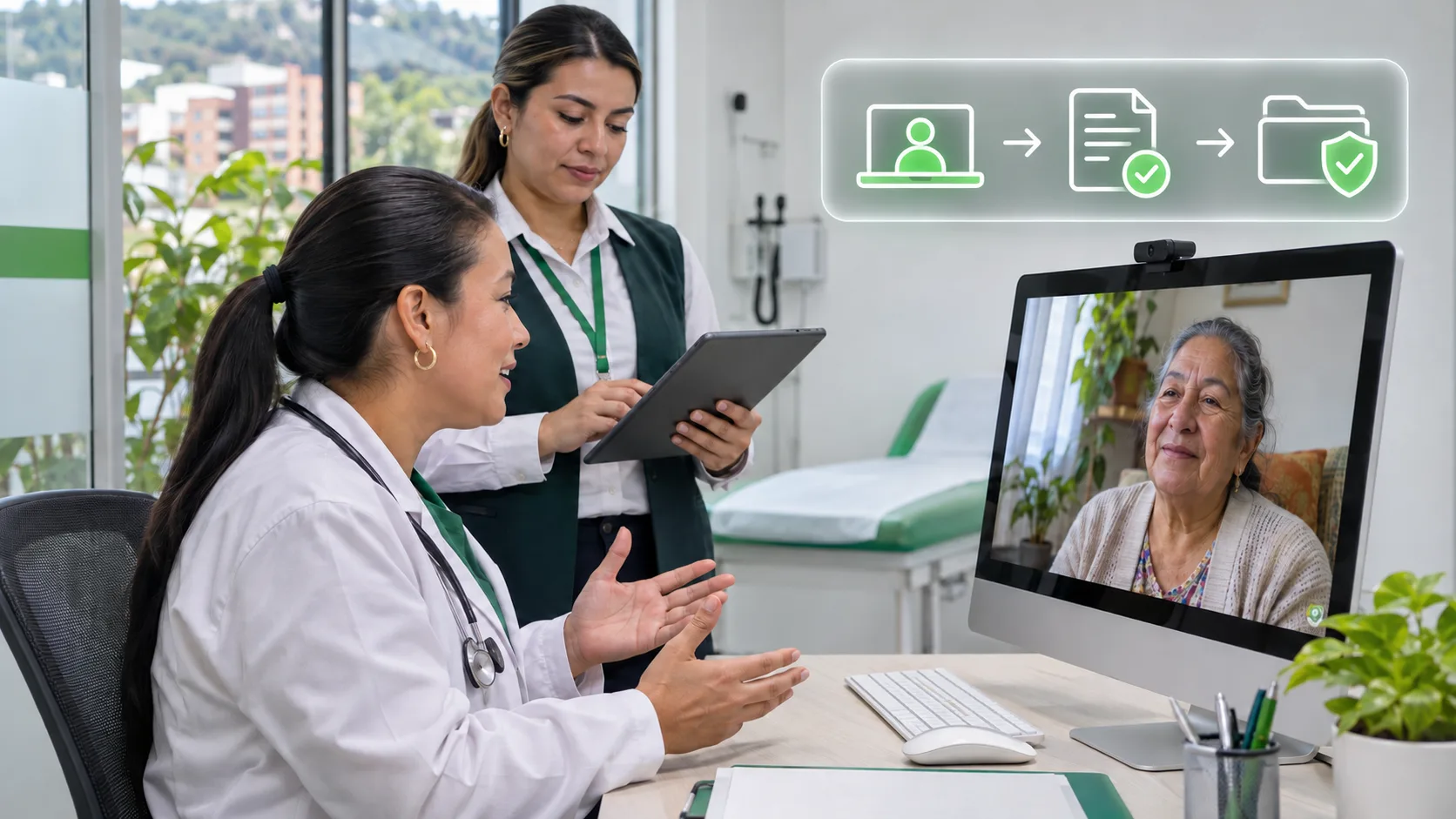
If your institution already had services accredited under the telemedicine modality, Resolution 2654 of 2019 is no longer the reference. Resolution 1644 of 2026 replaced it with more precise rules on how services are classified, what the platform must offer and how each encounter is documented.
In this article we summarize what changes and what to review during the transition. It is an operational guide: it does not replace the official text or your legal team's review.
1. What Resolution 1644 of 2026 is and who it applies to
Resolution 1644 of 2026 sets the requirements for telehealth activities and for the delivery of health services under the telemedicine modality. It applies to health service providers, community-based organizations, EPS (health insurers) or whoever acts in their place, ARL (occupational risk insurers) in their health activities, territorial entities and the Superintendencia Nacional de Salud (National Health Superintendency).
The regulation covers several fronts: the difference between telehealth and telemedicine, the four categories of telemedicine, platform and medical record requirements, the use of artificial intelligence, consent and data protection, and remote prescribing.
2. Telehealth and telemedicine: what requires accreditation
Telehealth groups information, support and education activities, such as tele-guidance (teleorientación), tele-support (teleapoyo) and tele-education. It is not a clinical service and does not require accreditation. Telemedicine, by contrast, is the remote delivery of health services and must be accredited in the REPS (Special Registry of Health Service Providers).
The difference has practical consequences. Tele-guidance serves to inform, warn about risks and direct the user to the right service, but it does not allow prescribing medicines or issuing orders or sick leave certificates. For the general definition and the types of remote care, see what is telemedicine.
3. The four categories of telemedicine
Resolution 1644 recognizes four categories. Each one defines who takes part, what type of communication it uses and whether it allows prescribing. The categories of Resolution 2654, such as interactive and non-interactive telemedicine, are no longer in force.In the three categories that allow prescribing, prescriptions may only be issued by legally authorized health professionals.
| ||||||||
| Category |
| Who takes part and what for |
| Communication |
| Allows prescribing medicines? |
|
|---|---|---|---|---|---|---|---|---|
| ||||||||
| Teleconsultation (teleconsulta, art. 18) |
| A professional cares for the user, who connects from home or from a link point (punto de enlace). There can also be a deferred exchange between professionals at two nodes |
| Synchronous or asynchronous interactive |
| Yes |
|
| ||||||||
| Tele-expertise (telexperticia, art. 16) |
| The user is accompanied in person by a professional or support staff, and a remote professional or specialist takes part |
| Synchronous interactive |
| Yes |
|
| ||||||||
| Tele-opinion (teleconcepto, art. 17) |
| The referring team requests an interconsultation or an opinion. Technicians or technologists may take part and, in real time, the user when required |
| Synchronous or asynchronous interactive |
| Yes |
|
| ||||||||
| Telemonitoring (telemonitoreo, art. 19) |
| Remote clinical follow-up. It may involve the user, health teams at different nodes or prehospital care staff |
| Synchronous or asynchronous interactive |
| No |
|
The regulation also defines where care takes place. The referring node is the service where the interaction originates, and the reference node is the one that responds to that request. The patient does not have to be at the referring node: they can connect from home or from a link point, a community or territorial space designed for rural and dispersed areas. The link point does not require its own accreditation, but it does need sufficient infrastructure, technology and connectivity.
4. Platform requirements, recording and WhatsApp
The telemedicine platform must be interoperable with the electronic medical record, without duplicating or fragmenting records, and the provider's medical record is the official record of care. Interoperability follows the standards of Law 2015 of 2020 and Resolutions 866 of 2021 and 1888 of 2025.
This does not require the video call to live inside the medical record software. It can run on a separate tool, as long as it is properly licensed, has security and information integrity certification and has data backup and recovery mechanisms.
Recording has specific rules. The platform must allow recording, and the institution decides when to record. If it records, it must request authorization from the user and the professional, and add the file to the medical record as an electronic document, with the applicable retention periods.
On WhatsApp, the regulation is explicit: instant messaging apps, such as WhatsApp, and social networks do not meet the requirements for delivering telemedicine. In practice, this separates two uses. Clinical care must take place on a platform that meets the requirements, and this includes asynchronous teleconsultation, which allows deferred exchanges as long as they happen through that platform. Administrative tasks, such as confirming an appointment or sending the access link, can continue over messaging, under the applicable data protection rules.
To learn how to connect clinical systems, read our guide on interoperability with the medical record.
Telemedicine platform for clinics and hospitals.
Video consultations connected to your institution's scheduling and reminders.
5. Artificial intelligence: what the regulation allows
Resolution 1644 allows artificial intelligence to be used as technological support in telemedicine, under professional supervision. The professional keeps clinical control and can review, validate or reject recommendations. In no case can AI replace clinical judgment.
Before using it, the provider must inform the patient that AI will be used, its scope and limits, and who is responsible for it. The tool must allow its contributions to be logged and audited, and AI with clinical impact requires documented technical and clinical validation. If it is classified as a medical device, it needs registration, permit or authorization from INVIMA (Colombia's food and drug regulator) when required.
The Ministry has 12 months from the issuance of the regulation to publish technical guidelines on the use of AI in telemedicine. In the meantime, it is worth listing which AI tools the institution uses and for what: transcribing a consultation is not the same as suggesting a diagnosis.
6. Consent and sensitive data
Before a telemedicine encounter, health staff must obtain informed consent from the patient or their representative, explaining how the encounter works, its benefits, risks and limitations, and what happens if the connection fails. Evidence of consent is recorded in the institution's information systems, as applicable.
For minors, informed consent from parents, guardians or legal representatives is required, along with the minor's assent when their age and maturity allow it. The user can revoke consent at any time, and it is the professional who determines whether the clinical situation requires in-person care.
Consent to care does not replace authorization to process personal data. Health data is sensitive, and processing it requires prior, express and informed authorization from the data subject. Learn more in our guide on health data protection.
7. Billing for telemedicine services
For management and billing teams, article 37 is one of the most practical parts of the regulation. Telemedicine services are billed with the current CUPS codes (Colombia's unified procedure codes), and the modality is reported in the corresponding field of the RIPS (individual health service records).
If the modality is properly recorded in the RIPS and the supporting documents, the EPS cannot object to the claim on that basis.
8. Entry into force and transition periods
Resolution 1644 was issued on July 31, 2026 and, according to its article 44, it takes effect from that date. It was published in the Diario Oficial (Official Gazette) No. 53,618 on September 7, 2026.
Providers that already had services accredited under the telemedicine modality have 12 months to adjust (art. 43). The Ministry, for its part, has 12 months from issuance to publish the technical guidelines on AI (art. 23). To set internal compliance dates, it is advisable to confirm how the period is counted with the institution's legal team.
Service accreditation is still governed by Resolution 3100 of 2019 and its amendments. Resolution 1732 of 2026, which sought to replace it, was revoked by Resolution 2080 of 2026. Resolution 1644 does not by itself create a re-registration process by category, but it is worth checking that the REPS reflects the services offered under the telemedicine modality.
9. Compliance checklist for the IPS
This list helps divide the work among quality, accreditation, legal, IT and operations:
Place each telemedicine service in one of the four new categories.
Check that the REPS reflects the services you offer under the telemedicine modality.
Review the platform's interoperability with the medical record and the recording of each encounter.
Check that the video call tool is licensed, has evidence of security and information integrity, and has backup and recovery mechanisms.
If you offer asynchronous teleconsultation, document the maximum response times by service and inform the user at the start of care.
Move clinical care to the platform and keep messaging for administrative tasks only.
Update informed consent and separate the authorization for data processing.
Define your recording policy: when recordings are made, how they are authorized and how they are added to the medical record.
List your AI tools and document how the patient is informed, how each one is audited and how it was validated.
Check that billing uses the current CUPS codes and that the RIPS report the telemedicine modality, with the supporting documents that back it.
Write the contingency protocols and the criteria for referral to in-person care.
Frequently asked questions
How long do providers that already had accredited telemedicine services have to adjust?
They have 12 months to adjust to Resolution 1644 of 2026 (art. 43). The regulation was issued on July 31, 2026, takes effect from that date according to its article 44, and was published in the Diario Oficial on September 7. It is advisable to confirm how the period is counted with the legal team. During that time, it helps to reclassify services, review the platform and billing, and update consent.Can WhatsApp be used to deliver telemedicine?
No. Article 24.5 of Resolution 1644 of 2026 states that instant messaging apps, such as WhatsApp, and social networks do not meet the requirements for delivering telemedicine. Care, including asynchronous teleconsultation, must take place on a platform that meets the regulation. Messaging can still be used for administrative tasks, such as confirming an appointment or sending the access link, while respecting data protection.What does a telemedicine platform need to be interoperable with the medical record?
It must exchange information with the provider's electronic medical record, which is the official record of care, without duplicating or fragmenting data. Resolution 1644 refers to the standards of Law 2015 of 2020 and Resolutions 866 of 2021 and 1888 of 2025. The video call can run on a separate tool if it is licensed, secure and has data backup.Can artificial intelligence be used in a teleconsultation?
Yes, as support and under professional supervision. The professional keeps clinical control and can review, validate or reject recommendations; AI never replaces clinical judgment. Beforehand, the patient must know that AI is used, with what scope, limits and who is responsible. The tool must allow logging and auditing, and AI with clinical impact requires documented technical and clinical validation.Compliance work starts with an inventory: which services the institution provides today, which category each falls into and which tools are used to deliver them. From there, each institution can estimate its gaps and set priorities. To see how a virtual consultation connected to scheduling works, explore COCO's telemedicine platform for clinics and hospitals.
Request a demoSee how a virtual consultation works with COCO.
We show you how a virtual consultation is organized with COCO, from the appointment to the encounter.
COCO in the press
What independent media have published on this topic.
Related articles
COCO vs AgendaPro: what clinics in Colombia need to reduce no-shows and improve operations
In healthcare, a schedule is not just a calendar. It is revenue, access, continuity of care and patient experience. When an appointment is missed, the institution does not only lose a time slot. It loses installed capacity, team time and operational margin
What is telemedicine and how it works in clinics and hospitals in Colombia
What telemedicine is, its types (synchronous, asynchronous, telemonitoring), the legal framework of Resolution 2654, and how it integrates into a clinic's scheduling flow.

COCO vs. Cliniweb: two very different ways to approach healthcare scheduling
Many healthcare institutions in Panama discover that a traditional scheduling tool does not solve the real problem: no-shows, underused capacity, operational friction, and limited interoperability. This article compares COCO and Cliniweb to show which type of institution fits each solution and when an access platform can drive better efficiency and results.