Multichannel Appointment Reminders: Building a Flow Patients Answer
A practical guide to multichannel appointment reminders that increase responses, reduce no-shows, and lower administrative workload.
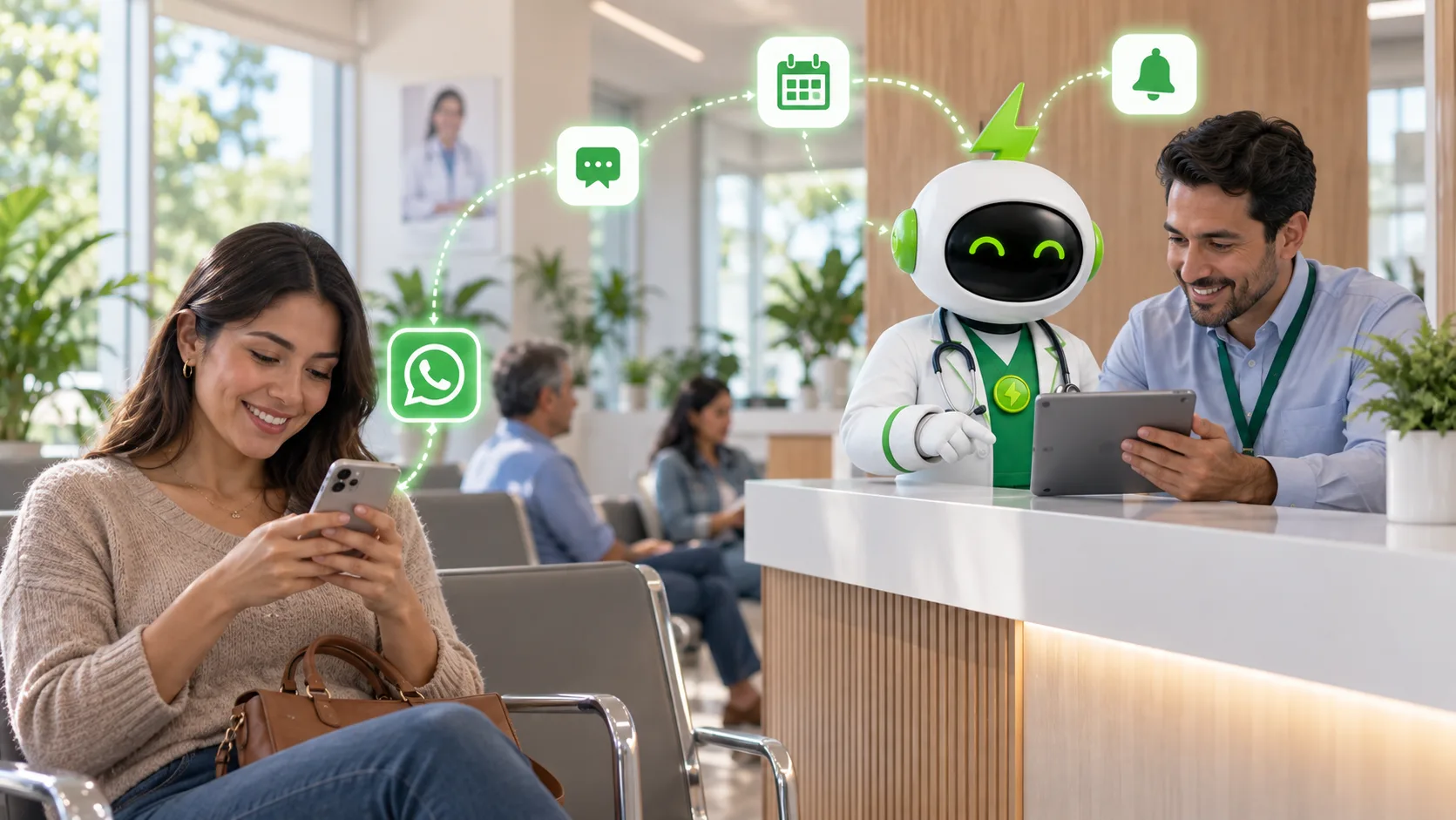
Short answer: Build a conditional sequence: start with the patient’s available, preferred channel, use WhatsApp for replies, SMS for brief alerts, and calls as an alternative. Define when to switch channels, stop pending attempts when a response arrives, and route exceptions to staff. Connect the workflow to medical scheduling software so every channel uses the same appointment status.
Scope: this guide applies to any clinic. If you operate in Medellín, also see AI appointment reminders for Medellín clinics.
The challenge with reminders is not only the channel. It is the workflow: when contact happens, what the patient is asked, what happens after a response, and how the organization acts when there is no response.
For clinics and healthcare providers, an effective reminder should reduce patient uncertainty and give operations a useful signal. A multichannel strategy is not about repeating the same message everywhere. It is about combining channels with clear logic.
Turn reminders into useful responses
COCO connects confirmation, rescheduling, and appointment recovery in one journey.
Patients do not respond in only one way
Some people prefer WhatsApp, others check email, and others need a call. There are also differences by age, service, urgency, connectivity, and care model. A rigid workflow may reach many patients without producing an actionable response.
The goal is to obtain the signal scheduling needs: confirmation, date change, cancellation, or routing. The message should be short, clear, and consistent with care rules.
How to design a multichannel flow that works
1. Define the timing of each contact
The first contact can confirm that a request was received. Later contacts should move closer to the appointment date and respond to patient behavior. Not every specialty needs the same timing.
2. Give each channel a purpose
WhatsApp can support quick replies and changes. SMS can deliver a short alert. Email can provide more context. An automated call can help when the organization needs another way to reach the patient.
3. Prevent conflicting messages
Every channel should consult the same availability and record the same outcome. Integration with medical scheduling prevents offering a slot that no longer exists.
4. Design the no-response path
Silence also needs a rule. It can trigger another channel, team review, or slot recovery. COCO can combine confirmations with up to six attempts according to the configured journey.
What changes for administrative teams
When the organization receives structured responses, teams spend less time reviewing conversations one by one. They can focus on authorizations, special cases, and patients who need human support.
This improvement connects with the automated waitlist: a timely cancellation can trigger an offer to patients already waiting. The reminder becomes a capacity tool rather than an isolated message.
How to measure whether the flow works
- Response by channel and attempt.
- Confirmations compared with delivered messages.
- Rescheduling completed before the appointment.
- No-shows by service and population.
- Slots recovered after a cancellation.
- Cases requiring human intervention.
The WHO recognizes digital health as a way to strengthen health systems. In practice, transformation becomes visible when communication reduces friction and improves continuity.
The best strategy learns over time
An organization can begin with one service, compare channels, and adjust contact timing. It can then expand to other sites and specialties. COCO supports that evolution through rules, traceability, and indicators rather than assumptions.
A self-service and appointment recovery case
The value of multichannel reminders appears when patients can complete the task without depending on a call center. In the Messer Colombia Homecare case, self-service increased from 35% to 55%, more than 13,000 appointments were managed monthly, and 63% of appointments were reported as recovered.
This does not mean every patient should receive the same message. It means the institution must combine channel, timing, and action: confirm, change, cancel, or recover. The design needs one availability source so WhatsApp, SMS, email, and internal teams work from the same status.
Metrics for improving the journey
- Share of patients completing the task without human assistance.
- Response by channel, site, service, and time window.
- Time from the first message to confirmation or rescheduling.
- Slots released and appointments recovered through the waitlist.
With this information, COCO can help refine contact rules, activate the automated waitlist, and connect the outcome to the schedule. The priority is for every interaction to end in a clear operational status.
What is a multichannel reminder?
What should happen when a patient does not respond?
Should all channels show the same information?
Frequently asked questions
Which channel should be used first based on patient availability?
Start with a channel the patient can access and has identified as preferred, considering connectivity, language, and contact hours. WhatsApp can support confirmations and changes; SMS works for brief alerts when mobile data is unavailable; a call may be more appropriate when the patient needs assistance. Avoid imposing the same channel order on every patient.
When should the channel change if there is no response?
Switch when the response window defined for that contact expires or a delivery failure is detected. Adjust that window to appointment proximity, service requirements, and the patient’s contact hours; there is no universal interval. Before triggering an SMS or call, check that no response has already been recorded and apply a limit to contact attempts.
How should messages stop once the patient responds?
Design the workflow to record each response in a status shared across channels and cancel pending attempts for the same request. A confirmation should end confirmation requests; a cancellation or rescheduling should update the schedule. If the response is unclear, pause the sequence and route it for review rather than continuing to send reminders.
Which responses should be escalated to an agent?
Route unclear replies, requests outside scheduling rules, authorization issues, accessibility needs, and explicit requests for human help to staff. Clinical questions should go to the appropriate care team rather than being handled as administrative tasks. Give the agent appointment context and previous contact history, and pause automated attempts while the case is under review.
COCO in the press
What independent media have published on this topic.
- PortafolioSoftware scheduling 140,000+ medical appointments a month wins Ingenio 2025 Award
- Valora AnalitikColombian medical scheduling software wins award
- LatinPymeSoftware scheduling 140,000+ appointments a month wins Ingenio 2025
- Enter.coStanford recognizes COCO Tecnologías, the startup using AI for appointment access
Related articles
From Scheduling to Care: How to Improve Patient Flow
Learn how to connect scheduling, confirmation, waiting, and care to reduce friction and improve patient flow.
Front-Desk Administrative Workload: What Automation Removes
A task-by-task look at the front desk: what automation absorbs, what stays human and how staff time is reused.

Induced Demand in Healthcare in Colombia: From Patient Lists to Completed Appointments
How patient activation works in Colombia: Health Benefit Plan list cleansing, omnichannel outreach, appointment scheduling, and patient-level traceability.