Front-Desk Administrative Workload: What Automation Removes
A task-by-task look at the front desk: what automation absorbs, what stays human and how staff time is reused.
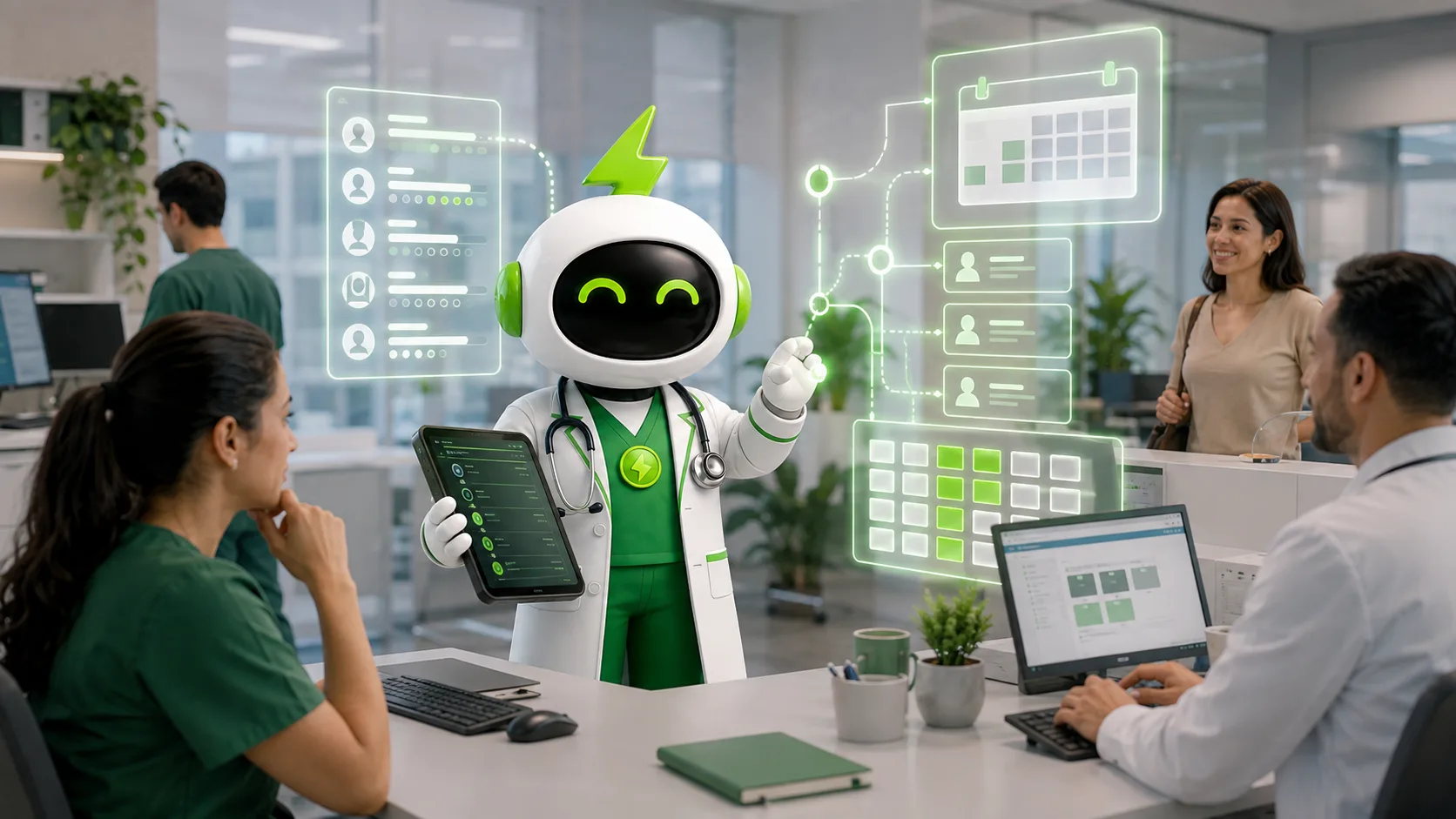
Short answer: Reduce administrative workload by automating availability checks, confirmations, reminders, and appointment changes under clear rules for each service, location, and clinician. COCO’s medical scheduling software helps reduce manual work and route exceptions to responsible staff. Measure administrative time before and after automation, then redirect recovered hours toward patient guidance and cases that require human judgment.
In a clinic, hospital, or healthcare provider in Latin America, staff burnout does not come only from clinical care. It also builds up through repetitive work: answering requests, finding openings, confirming appointments, moving patients, and calling again when a slot becomes available.
Automated scheduling can remove part of that friction without taking clinical control away from the team. The organization defines rules, services, professionals, and hours; technology helps execute the process with greater continuity and traceability.
How much time could your team recover with smarter scheduling?
See how COCO helps organize schedules and automate access-to-care interactions.
Administrative workload also affects care capacity
When staff must handle every request manually, the schedule becomes a series of interruptions. The problem appears as unanswered calls, pending messages, duplicate appointments, changes that are not reflected in time, and slots lost because no one confirmed them.
- centralize appointment requests and essential patient information
- show availability by service, site, and professional
- automate confirmations, reminders, and change requests
- identify cancellations to trigger an organized slot recovery flow
- give staff an exceptions view instead of an endless task list
What it means to automate with clinical judgment
Automation does not mean accepting every appointment without context. It means designing a workflow in which institutional rules guide each step and special situations reach a responsible person. Staff can then focus on exceptions, patient guidance, and service quality.
A useful model for clinics and healthcare providers
- Map the current journey from request to care.
- Separate repetitive tasks from decisions that require professional judgment.
- Define scheduling, capacity, channel, and permission rules.
- Measure response, confirmation, rescheduling, and recovered-slot times.
- Refine the workflow using data, staff feedback, and patient experience.
The LATAM context requires flexibility
Organizations in the region work with different payers, sites, specialties, communication channels, and levels of digital maturity. An implementation should adapt to the real operation and coexist with existing processes instead of forcing one path.
COCO's medical scheduling solution can complement an automated waitlist when an organization needs to respond to requests, reduce manual work, and use capacity more effectively.
The WHO explains that digital health should strengthen health systems and support more accessible care. In practice, that requires technology, clear rules, training, and outcome monitoring.
How to evaluate the impact
The goal is not to count how many automations were triggered, but to see what changed operationally. Track staff time spent on administrative tasks, response speed, confirmation rates, handled changes, and the share of capacity recovered.
What tasks can automated scheduling support?
Does automation replace healthcare staff?
Can it work for organizations of different sizes?
Frequently asked questions
Which reception tasks should be automated first?
Prioritize frequent, repetitive tasks with stable rules: checking availability, sending confirmations and reminders, and handling straightforward appointment changes. Record their volume and staff handling time before automating them. Keep ambiguous requests, scheduling conflicts, and any decision requiring clinical judgment under human review rather than treating every request as a standard booking.
How can administrative hours saved by team be measured?
Record each team’s task volume and active handling minutes before and after automation. To compare equivalent workloads, multiply task volume by the reduction in handling minutes and divide by 60. Include time spent on oversight, corrections, and exceptions in the post-automation workload. Report recovered staff capacity separately from financial savings, which are not automatic.
How should roles change after scheduling automation?
Assign clear owners for reviewing exceptions, resolving scheduling conflicts, and guiding patients who need assistance. Redirect recovered time toward these responsibilities based on observed demand rather than the previous staffing structure alone. Document who can change scheduling rules, authorize adjustments, and escalate clinical questions, then review the allocation using staff feedback.
What training do staff need to handle exceptions?
Training should cover scheduling rules, permissions, data verification, change documentation, and escalation criteria. Practice scenarios such as ambiguous requests, duplicate appointments, or unavailable slots. Staff should know which issues they can resolve independently, when to involve a clinical professional, and how to continue assisting patients if the automated workflow is interrupted.
COCO in the press
What independent media have published on this topic.
- El TiempoClinics and hospitals grew appointment management over 24% using AI
- PortafolioSoftware scheduling 140,000+ medical appointments a month wins Ingenio 2025 Award
- Valora AnalitikColombian medical scheduling software wins award
- LatinPymeSoftware scheduling 140,000+ appointments a month wins Ingenio 2025
Related articles

Multichannel Appointment Reminders: Building a Flow Patients Answer
A practical guide to multichannel appointment reminders that increase responses, reduce no-shows, and lower administrative workload.
From Scheduling to Care: How to Improve Patient Flow
Learn how to connect scheduling, confirmation, waiting, and care to reduce friction and improve patient flow.

Induced Demand in Healthcare in Colombia: From Patient Lists to Completed Appointments
How patient activation works in Colombia: Health Benefit Plan list cleansing, omnichannel outreach, appointment scheduling, and patient-level traceability.