No-Shows in Medellin Hospitals: A Local Operational View
Medellin in focus: local causes of missed appointments, population profile and the measures that hold up in the city.
A missed appointment in Medellín is more than an empty slot. It can mean unused professional time, a room that cannot be reassigned, a patient who leaves the care journey and a service opportunity the institution fails to recover.
Colombia's Ministry of Health Waiting Times Management Model includes missed appointments among the phenomena that should be observed when managing capacity and access. The important point is that no-shows should be treated as a measurable operational problem, not as a personal failure by the patient.
Why no-shows require a local strategy
Medellín has a diverse network of clinics, hospitals, healthcare providers, outpatient services and specialties. The reasons for a missed appointment may vary by location, appointment type, wait time, booking channel, pending authorization, transportation, time of day and clarity of communication.
That is why copying a generic reminder campaign usually has limited impact. The institution needs to identify which services concentrate no-shows, when they occur and which signals appear before a patient stops attending.
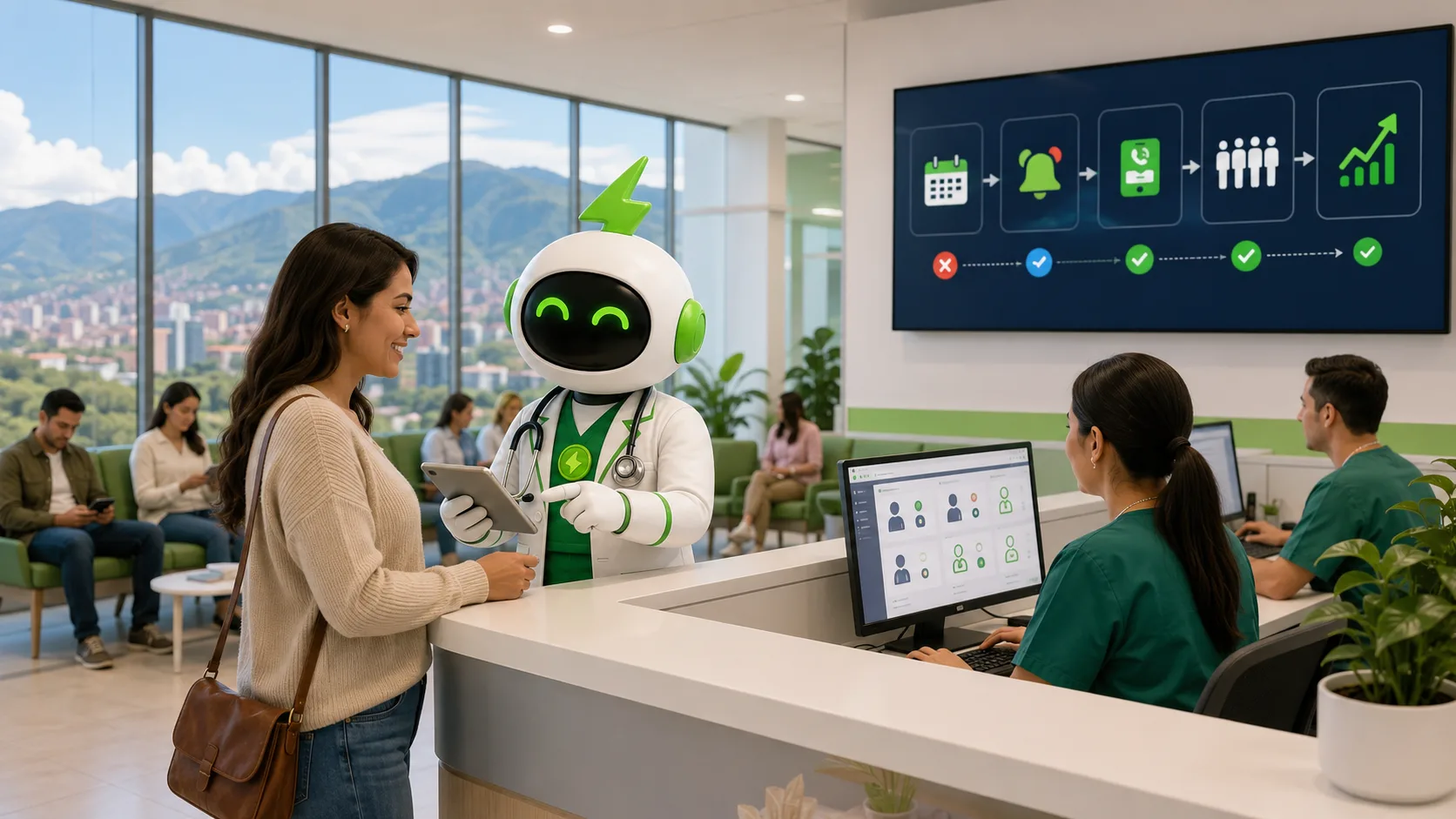
Four stages for recovering an appointment
- Confirm: send clear date, time, site, professional and requirement information.
- Detect risk: identify incomplete replies, missing confirmation or pending documents.
- Reschedule: offer alternatives before marking the appointment as lost.
- Recover capacity: release and reassign the slot with rules and traceability.
What a good reminder should say
An effective message does more than repeat the date. It reduces uncertainty and makes the next action simple. The patient should know where to go, what to bring, how to confirm, how to cancel and what to do if another time is needed.
- Institution and service identification.
- Date, time, site and arrival guidance.
- Simple buttons or replies to confirm or request a change.
- Authorization, order or preparation requirements when relevant.
- A support channel for exceptions.
Data for prioritizing intervention
The first dashboard should separate no-shows by variables the team can manage. A single organization-wide percentage is not enough.
- Site and neighborhood of care.
- Specialty, service and appointment type.
- Time between booking and appointment date.
- Source channel: phone, web, WhatsApp, referral or campaign.
- Contact outcome: confirmed, canceled, rescheduled or no response.
- Reported reason when the patient shares it.
A study on predicting no-show behavior in care programs in Bogotá, published on arXiv, illustrates how historical data can support targeted interventions. The model does not replace the patient conversation; it helps focus resources where early action may recover the slot.
How COCO can help
COCO Tech AI can connect medical scheduling with confirmations, multichannel communication, rescheduling and reporting. Instead of treating each appointment as an isolated record, the institution can manage a sequence of states and decide what to do when a patient does not confirm.
- Segmented campaigns by service, site or patient type.
- Confirmation and cancellation replies with state tracking.
- Alerts for upcoming appointments without a response.
- Released-slot reassignment under institutional rules.
- No-show, recovery and response-time reporting.
A 30-day plan for a Medellín healthcare provider
- Week 1: choose one pilot specialty and measure historical no-shows.
- Week 2: review messages, channels and cancellation reasons.
- Week 3: activate confirmation and rescheduling with daily follow-up.
- Week 4: compare attendance, recovered slots and staff workload.
The goal should not be to pressure or punish patients. It should be to make confirmation and timely cancellation easier and to offer a real alternative. The experience improves when the institution communicates clearly and patients have practical options.
Frequently asked questions
What are medical no-shows?
What is the best way to reduce them?
Does COCO only send reminders?
Conclusion
Reducing no-shows in Medellín requires turning each appointment into an accompanied process. With data, timely communication and recovery rules, clinics, hospitals and healthcare providers can recover capacity while preserving a human-centered approach to care.
Do you want to activate patients and recover capacity?
See how COCO helps reach patients, fill available slots, and support continuity of care.
COCO in the press
What independent media have published on this topic.
- El TiempoClinics and hospitals grew appointment management over 24% using AI
- Diario ADNIn Colombia, under 50% of hospitals offer digital scheduling and results
- InfobaeHow AI and automation will transform clinics and hospitals in 2026
- Noticias RCNTrends that will transform clinics and hospitals in 2026
Related articles

How to Connect Scheduling to an HIS Without Replacing It
A guide to connecting medical scheduling with an HIS, clarifying ownership, and improving access without replacing existing systems.
How to Reduce Medical No-Shows with Active Confirmation
Learn how active confirmation helps clinics reduce no-shows and recover appointments before clinical capacity is lost.
How Clinics Lose Revenue and How COCO Helps Recover It
The revenue leaks behind healthcare organizations and how COCO connects its solutions to recover appointments, capacity, and efficiency in LATAM.