How Clinics Lose Revenue and How COCO Helps Recover It
The revenue leaks behind healthcare organizations and how COCO connects its solutions to recover appointments, capacity, and efficiency in LATAM.
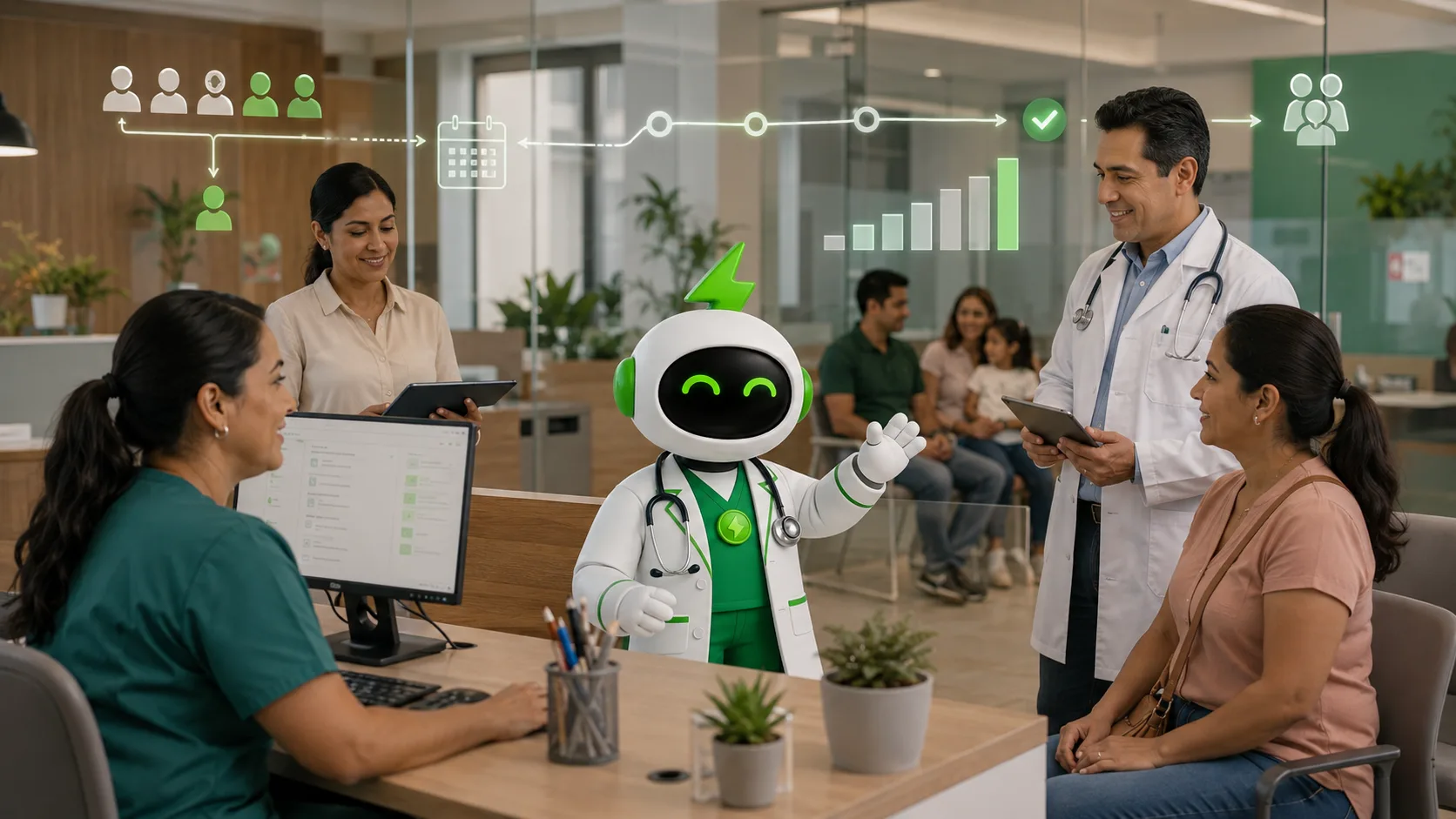
Healthcare organizations do not always lose revenue because they lack patients. They often lose it because an appointment is not confirmed, a canceled slot stays empty, a medical order takes too long to validate, a surgery is rescheduled, or staff spend hours on work that could be connected.
The problem appears as small leaks, but they accumulate across every site, service, and shift. For a Latin American clinic or healthcare provider, recovering revenue starts by identifying where the journey from demand to care breaks down.
How much revenue is leaking from your operation?
See how COCO connects AI solutions to recover capacity, reduce no-shows, and improve revenue.
Four capabilities that protect clinical capacity
When an organization loses revenue, there is usually an operational step that could happen sooner. COCO focuses on four moments that often determine whether an appointment is completed or a slot is wasted.
Configurable business rules
Clinics and healthcare providers do not operate with one universal rule. Requirements vary by site, service, professional, payer, clinical resource, and care type. COCO lets organizations configure these criteria so scheduling reflects the operation they actually run.
Self-service where patients already are
WhatsApp, web, patient portals, SMS, email, and automated calls can be part of the journey. Patients can request, confirm, cancel, or reschedule with less friction, while teams retain traceability without handling every change by phone.
Multichannel reminders
COCO can structure up to six confirmation attempts using email, WhatsApp, automated calls, and SMS. This allows organizations to adapt contact to patient response and measure which channels work best for each service.
Recovery of released appointments
A cancellation does not have to end as an empty hour. The automated waitlist helps offer the slot to prioritized patients, while patient engagement campaigns can activate care opportunities that have not yet reached the schedule.
These capabilities are strengthened by Clinical OCR, telemedicine, surgical management, and COCO Pay. The result is a more connected operation, less repetitive work, and greater capacity to turn demand into care.
Where healthcare organizations lose money
- No-shows: a reserved appointment that is not completed leaves clinical capacity unused.
- Late cancellations: when no one can offer the slot in time, revenue is lost even when demand exists.
- Manual processes: calls, validations, and data entry consume resources that could support patients.
- Disconnected demand: people who need care cannot find a clear path to an appointment.
- Separate payments: missing financial confirmation adds friction between booking and care.
- Uncoordinated surgical workflows: a room, supply, or authorization delay can affect the entire schedule.
What COCO does to recover value
COCO connects different moments of the patient journey so the organization can act before an opportunity is lost:
- AI medical scheduling to receive requests, show availability, and confirm appointments.
- Automated waitlist to offer canceled slots through WhatsApp to prioritized patients.
- Patient flow and waiting room tools to organize calling, improve in-person flow, and reduce admissions workload.
- Telemedicine to expand care options when appropriate for the service and patient.
- Surgical management to coordinate scheduling, rooms, resources, and surgical follow-up.
- Induced demand and patient outreach to contact populations, activate services, and turn identified needs into care.
- Clinical OCR to read and validate orders or documents, reduce rework, and speed decisions.
- COCO Pay to collect appointment payments through WhatsApp and confirm the booking when payment is completed.
COCO compared with Xenco, in brief
For the complete comparison, read our article COCO vs Xenco: The Better Way to Modernize Healthcare.
Xenco presents itself as a healthcare ERP with broad administrative and clinical scope. COCO has a different advantage: it concentrates automation on the points where an organization loses care opportunities and revenue, from request to confirmation, payment, slot recovery, and follow-up.
That makes COCO a strong choice when the priority is to improve visible outcomes in access, utilized capacity, and patient experience, even when an organization already has other core systems.
From leakage to outcome
- Identify where appointments, time, or revenue are being lost.
- Connect each process with the COCO solution that fits it.
- Define rules, owners, and exceptions.
- Measure confirmations, recovered slots, time, payments, and completed care.
- Scale the model across sites and services.
PAHO recommends linking digital transformation to capabilities, governance, and measurable outcomes. For LATAM organizations, that means looking beyond isolated leaks and building a connected journey that protects installed capacity.
What to measure after implementation
The depth of a solution is demonstrated through indicators. Before activating a workflow, an organization can establish a baseline for no-shows, appointment availability, response time, incoming calls, and slots lost after cancellations. Those measures then show which rule works, which channel gets the best response, and where teams still need to intervene.
A pilot for a high-volume hospital network can be designed around a baseline of monthly appointments and priority-service measurements over several months. Its goals can include reducing no-shows, improving appointment availability, and increasing self-service adoption. Each organization should define its own objectives, but the principle shows how to turn a technology discussion into a measurable plan.
Integration also protects the investment
An organization should not have to replace its HIS to improve access. COCO can connect with clinical systems, billing, call centers, and digital channels when responsibilities and data exchanges are clearly defined. Standards such as HL7 FHIR provide a common language for planning healthcare integrations, although every project needs its own technical validation.
Integration allows a confirmation, cancellation, payment, or processed order to trigger the next step without duplicating work. The organization gains a clearer view of the journey and can identify more quickly where capacity is being lost.
A staged improvement path
- Choose a service where no-shows or pending demand have a visible impact.
- Configure rules, channels, and owners with the operations team.
- Activate confirmation, slot recovery, and self-service.
- Compare results with the baseline and adjust exceptions.
- Extend the model to other sites or services once the learning is proven.
This method helps clinics and healthcare providers move with control. Technology does not replace institutional management: it gives decisions better information and creates a clearer path for every care opportunity.
How do clinics lose revenue?
How does COCO help recover revenue?
Can COCO complement a system such as Xenco?
COCO in the press
What independent media have published on this topic.
- Diario ADNIn Colombia, under 50% of hospitals offer digital scheduling and results
- PortafolioSoftware scheduling 140,000+ medical appointments a month wins Ingenio 2025 Award
- Valora AnalitikColombian medical scheduling software wins award
- LatinPymeSoftware scheduling 140,000+ appointments a month wins Ingenio 2025
Related articles

How to Connect Scheduling to an HIS Without Replacing It
A guide to connecting medical scheduling with an HIS, clarifying ownership, and improving access without replacing existing systems.

How to Reduce Medical No-Shows with Active Confirmation
Learn how active confirmation helps clinics reduce no-shows and recover appointments before clinical capacity is lost.

COCO vs Xenco: The Better Way to Modernize Healthcare
A clear comparison to choose the software that best helps a LATAM clinic or healthcare organization grow with COCO.