Clinics That Grew in 2025 by Optimizing Medical Appointments
In 2025, while many clinics were shutting down services, others grew by more than 24% by optimizing medical appointment management with technology and artificial intelligence, improving efficiency, EBITDA, and patient access without expanding infrastructure.
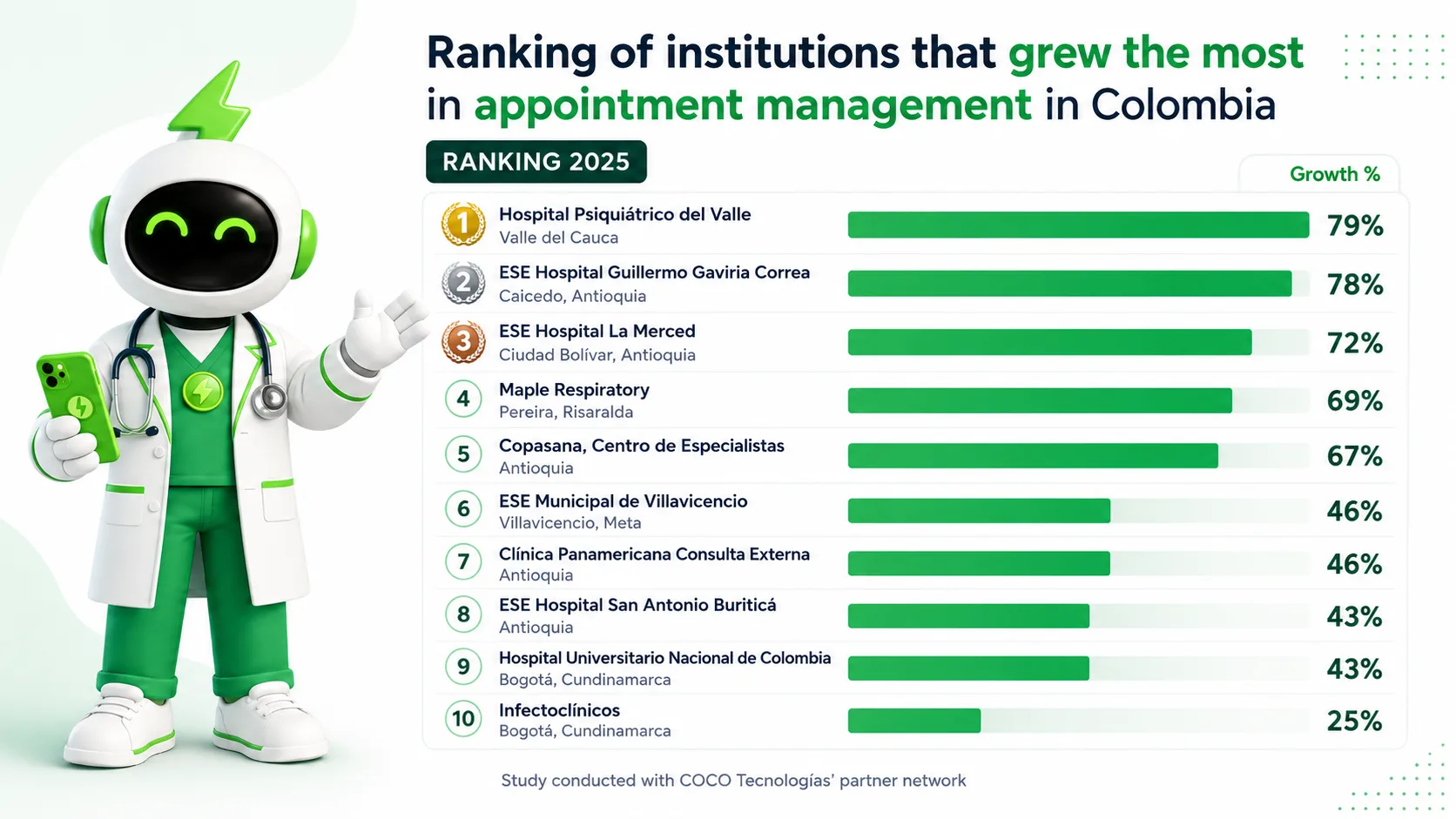
Short answer: COCO’s 2025 ranking reports appointment-management growth of 25% to 79% across ten institutions and links to media coverage. This is descriptive evidence, not proof of financial growth or AI causality: metric definitions, baseline volumes, and comparison periods are missing. When evaluating AI medical scheduling software, request those details before treating the results as a benchmark.
Clinics and Hospitals That Grew the Most in 2025 Thanks to AI in Medical Appointment Management
When technology is used well, it doesn’t replace people: it frees capacity to save more lives
2025 will go down as one of the most challenging years for the healthcare system in the last decade. While many institutions were forced to shut down services, reduce schedules, or slow their operations, a group of clinics and hospitals made a different decision: optimize instead of stopping.
The results were undeniable.
Today, COCO Technologies proudly presents the Top 10 Ranking of healthcare institutions that grew the most in 2025, proving that the real competitive advantage was not size or budget, but operational efficiency powered by technology and artificial intelligence.
2025 Ranking: Institutions That Grew the Most by Optimizing Appointment Management
These are the organizations that led growth in 2025 by optimizing processes and strategically applying AI in healthcare:
Hospital Psiquiátrico del Valle – Valle del Cauca (+79%)
ESE Hospital Guillermo Gaviria Correa – Caicedo, Antioquia (+78%)
ESE Hospital La Merced – Ciudad Bolívar, Antioquia (+72%)
Maple Respiratory – Pereira, Risaralda (+69%)
Copasana, Centro de Especialistas – Antioquia (+67%)
ESE Municipal de Villavicencio – Villavicencio, Meta (+46%)
Clínica Panamericana – Outpatient Services – Antioquia (+46%)
ESE Hospital San Antonio Buriticá – Antioquia (+43%)
National University Hospital of Colombia – Bogotá (+43%)
Infectoclínicos – Bogotá (+25%)

Study conducted with the COCO Technologies partner network.
2025: The Year Some Clinics Grew While Others Stopped
At the most challenging moment for the healthcare system, these institutions understood something critical:
the problem was not a lack of demand, but bottlenecks in medical appointment management.
By optimizing clinical and administrative processes with specialized technology, they achieved:
Increased revenue and EBITDA by using operational efficiency as a growth lever.
Served more patients without expanding infrastructure.
Reduced rework, operational friction, and idle time.
Radically improved the patient experience.
Positively impacted thousands of lives.
The Real Bottleneck in Healthcare: Medical Appointments
The data is clear:
inefficient appointment management is one of the main barriers to access to healthcare across Latin America.
Through AI-powered medical scheduling technology, institutions using COCO were able to:
Reduce no-shows and cancellations.
Increase effective physician utilization.
Optimize clinical schedules in real time.
Unlock installed capacity without building new facilities.
A key insight
For every 10 clinics using COCO, it’s as if 3 new clinics were created, without adding a single square meter of infrastructure.
All by unlocking capacity through technology.
More Efficiency = More Access = More Lives Impacted
There is a direct relationship that can no longer be ignored:
More EBITDA → more physicians hired
More physicians → more access
More access → more lives saved
When applied correctly, technology does not replace human talent.
It multiplies it.
More Than 2,000 Healthcare Centers Are Already Doing It
At COCO Technologies, we have the privilege of supporting more than 2,000 clinics and hospitals that understand digital transformation in healthcare is not a luxury, but a strategic decision for sustainable growth.
This ranking does not celebrate revenue.
It celebrates vision, leadership, operational discipline, and a true commitment to patients.
National Recognition: Media Highlighting the Impact
This study and its results were featured by leading national media outlets, we invite you to explore the full articles and learn more about how technology reshaped healthcare growth in 2025.
We Continue Building Technology for One Purpose
At COCO, we continue developing solutions with one clear goal:
✔ To make healthcare more human
✔ More efficient
✔ And more accessible
Because when technology is used well, it doesn’t replace people.
It frees capacity to save more lives.
Want your clinic to be part of the next healthcare growth ranking?
Talk to a COCO Technologies expert and discover how to optimize your appointment management with AI.
What problem does Clinics That Grew in 2025 by Optimizing Medical Appointments address?
How can it be applied in a clinic, hospital, or healthcare provider?
Which indicators should healthcare leaders track?
Do you want to optimize medical scheduling?
See how COCO helps automate access, confirm appointments, and reduce operational workload.
Frequently asked questions
Which 2025 outcomes have an identifiable source?
The article attributes the ranking to a study of COCO Technologies’ partner network. Examples include +79% for Hospital Psiquiátrico del Valle and +25% for Infectoclínicos. It also links to coverage by Portafolio, El Tiempo, and Noticias RCN. The source is identifiable, but the text lacks baseline data and sufficient methodology to verify the percentages or treat them as independently audited results.
How can demand growth be distinguished from better utilization?
Demand growth means more requests for care; better utilization means using a larger share of available capacity. Compare requests, unique patients, completed appointments, and available slots, separating no-shows from cancellations. The ranking does not break down these variables. An increase in appointment management alone therefore does not demonstrate new demand, higher revenue, or clinic expansion.
Which comparison periods make a case valid?
An assessable case should state exact dates, compare equal-length windows, and account for seasonality, such as by comparing the same months in consecutive years. It should also use consistent measurement criteria and document changes in staffing, hours, locations, or services. The article names 2025 but does not specify the baseline period, preventing validation of comparability or isolation of AI’s effect.
Which documented practices could another clinic replicate?
The article describes real-time schedule optimization and appointment confirmation, and reports reductions in no-shows and cancellations. It does not document institution-specific protocols. These approaches can guide an evaluation, but replication requires assigning owners, recording operational changes, and comparing outcomes against a baseline. Measure actual capacity utilization rather than assuming another clinic will achieve the ranking’s reported growth percentages.
COCO in the press
What independent media have published on this topic.
- El TiempoClinics and hospitals grew appointment management over 24% using AI
- PortafolioSoftware scheduling 140,000+ medical appointments a month wins Ingenio 2025 Award
- Valora AnalitikColombian medical scheduling software wins award
- LatinPymeSoftware scheduling 140,000+ appointments a month wins Ingenio 2025
Related articles

Healthcare data privacy and AI: automating without losing trust
Trust is part of the operation, healthcare automation cannot scale if patient data is not protected. A poorly segmented campaign, exposed clinical data or an integration without traceability affects more than efficiency. It affects trust.
917,000 Missed Medical Appointments in Peru: The Hidden Cost Draining Private Clinics
EsSalud reported over 917,000 lost scheduled appointments between January and July 2025. Explore the impact of no-shows without extrapolating an annual total or promising guaranteed returns.

Digital Transformation in Healthcare: COCO Tech AI Facing the Operational Impact of Decree 0182 of 2026
"Revolutionizing healthcare with COCO Tech AI: Navigating Decree 0182's operational impact"