Medical scheduling module: what it is and what makes it truly intelligent
A medical scheduling module is not judged by its calendar, but by what it does when the schedule breaks down. We show you what a standard one offers and the five capabilities that turn it into a truly intelligent engine.
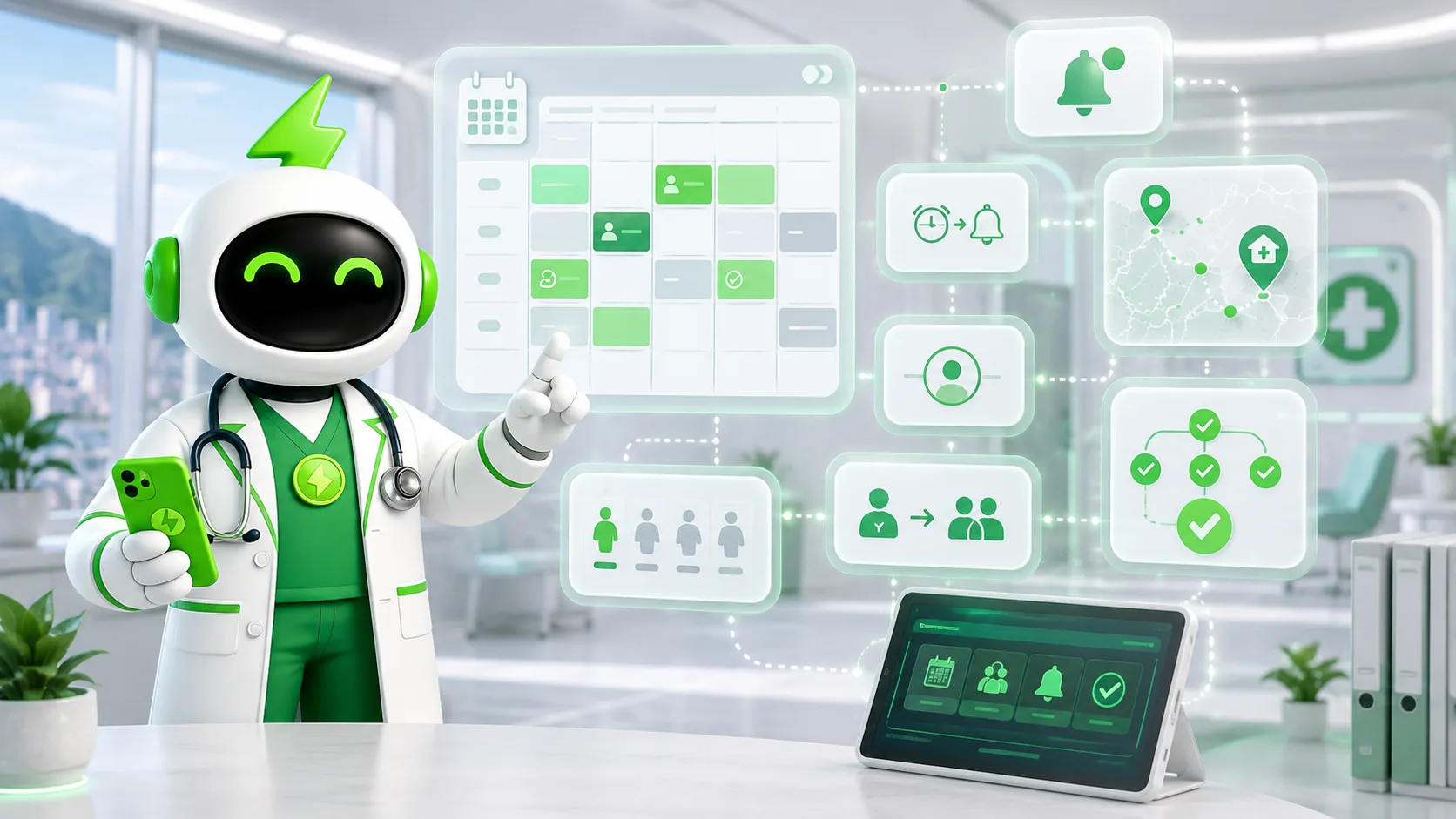
Short answer: An intelligent medical scheduling module coordinates appointments among patients, clinicians and clinical resources while helping manage disruptions and no-shows. It should include availability, configurable rules, multichannel booking, reminders, confirmations, appointment statuses, and clinical and administrative integrations. When evaluating medical scheduling software, also verify no-show prediction, canceled-slot recovery, exception handling and operational reporting.
A medical scheduling module is the health-software component that organizes the assignment of appointments among patients, physicians and clinical resources. Put that way, it sounds like a basic feature. In practice, it is where a large part of the operation's economics is decided: how many slots get filled, how many are lost, how much each confirmation costs and how much margin the institution recovers month after month. The difference between a standard module and a truly intelligent one is not whether it has a calendar or not: it is what it does when the schedule does not behave the way you expected.
What exactly is a medical scheduling module
A medical scheduling module is the subsystem within a clinical management software that handles three central tasks: booking slots according to each physician's availability, communicating the confirmation and reminder of the appointment to the patient, and recording the status of each slot (scheduled, confirmed, attended, canceled, no-show) to feed the institution's operational indicators.
In most Colombian clinics and hospitals, this module operates integrated with the electronic health record and the billing system. It receives patient data, assigns physical and human resources, and produces the events that feed the call center, the management reports and the audit processes. It is, in practical terms, the nervous system of the outpatient front end.
Up to this point, all providers offer roughly the same thing. The question that separates a commoditized option from one that changes the operation is the following: what does the module do when a patient probably will not show up, when someone cancels three hours in advance, or when a high-complexity slot becomes available?
What a standard scheduling module includes
A standard medical scheduling module, in today's Colombian market, offers a set of capabilities that are already considered the product's minimums. It is worth listing them to distinguish the basics from the differential:
-
Calendar by physician and by consulting room, with visibility of availability and blocks.
-
Multichannel scheduling, generally website, patient app, call center and, increasingly, conversational chatbot.
-
Automatic reminders by SMS, email or WhatsApp with configurable templates.
-
Attendance confirmation by the patient from the same channel as the reminder.
-
Basic operational reports: no-show rate, appointments attended per physician, outpatient occupancy.
-
Integration with the electronic health record and billing, so that the appointment flow continues to the other modules without double data entry.
All of that is necessary. None of it is sufficient to move the financial needle. If a clinic is evaluating providers solely on these features, it is comparing products that in practical terms do the same thing, and the decision will end up being defined by price, by interface or by the prior commercial relationship. Not by operational impact.
What turns a module into a truly intelligent one
The line that separates a standard module from a truly intelligent one lies in five additional capabilities. Each one solves a problem that the standard module simply does not touch, and each one is measured in financial indicators, not in user experience.
No-show prediction per scheduled appointment
An intelligent module does not treat all patients the same. It applies a model trained on the history of no-shows, the specialty, the day, the time, the distance to the care center and the patient's previous behavior in confirmations to assign a no-show probability score to each appointment. With that score, the operation changes: high-risk appointments receive focused human confirmation, medium-risk ones an automated double check, low-risk ones a standard reminder.
The call center team stops dialing in chronological order and starts dialing in order of impact. The difference in productivity per agent is on the order of 25% to 35%.
Automatic rescue of late cancellations
When a patient cancels their appointment three hours in advance, in a standard operation that slot is lost. The call center finds out late, manually working through the waiting list takes too long, and in the end the physician is left without a patient. An intelligent module with automatic rescue queries the waiting list filtered by specialty, physician and time slot, identifies the most viable candidate and sends an automatic proposal with a short response deadline. If the first candidate does not confirm, it moves on to the next.
For a clinic with 3,000 appointments per month and a 5% rate of late cancellations, that is 150 slots per month that go from being lost to being billed. In Colombian market figures, that is approximately $13 million pesos recovered per month through this channel alone.
Intelligent prioritization of available slots
A module with well-designed AI does not assign free slots on a first-come, first-served basis. It weighs clinical priority, patient risk, slot value and probability of attendance. When a physician has space and there are ten possible patients to assign it to, the system decides with combined criteria and keeps the care team out of the loop of micro-decisions.
Native connection with IVR and voicebot
For clinics with volumes above 2,000 appointments per month, neither the chatbot nor the human agent is enough to confirm everything. A truly intelligent module connects with interactive voice systems and voicebots that make hundreds of simultaneous calls, identify the patient's response and escalate to the human agent only the cases that require intervention. The call center stops operating by volume and starts operating by exceptions.
Steering installed capacity with data
The fifth capability is strategic, not operational. An intelligent module does not just automate the day-to-day: it produces data that allows management to decide on the institution's capacity. Is it worth opening a new subspecialty at the north branch? Is it better to hire another physician to reduce waiting times or to redistribute the existing slots? Which time slot is underused and could add care without expanding staff? The module does not answer these questions on its own, but it delivers the data that makes them answerable with evidence, not with intuition.
The operational impact in concrete figures
When these five capabilities work together, the effects are not incremental: they are structural. The clinics we work with at COCO report consistent results across four indicators:
-
Reduction of the no-show rate from the 20% - 22% range toward 8% - 12%, depending on the specialty mix and the maturity of the process.
-
Reduction of the access cost per attended slot above 80%, once the combined effects of prediction, rescue, voicebot and prioritization are consolidated.
-
Increase in the effective occupancy of outpatient care between 15 and 22 percentage points, without adding physical capacity.
-
Freeing up 60% to 75% of call center time dedicated to repetitive tasks, which shifts to handling exceptions and complex patients.
At COCO we position these four figures as the anchor of the business case before talking about features. The conversation with financial management does not start by asking which modules the system has; it starts by asking how much a slot costs today and how much it would cost with the complete system running.
Frequently asked questions
What is the difference between a medical scheduling software and a scheduling module within a clinical system?
The scheduling software is a standalone application focused exclusively on appointment assignment. The scheduling module is the piece within a comprehensive clinical system that performs the same function but connects natively with the electronic health record, billing, queue management and other components. In medium and large operations, the integrated module tends to outperform the standalone software because it eliminates double data entry and allows the scheduling data to feed the institution's general indicators without intermediate integrations.
Is a medical scheduling module the same as a chatbot?
No. The chatbot is a conversation interface with the patient; the scheduling module is the engine that manages the appointment. A module may or may not have a chatbot as an entry channel; what matters is what happens with the appointment after the patient requests it. The difference is measured in what happens when there is a probable no-show or a late cancellation, not in how the screen the patient converses with looks.
How long does it take to implement an intelligent scheduling module in a clinic?
For clinics with available historical data and defined administrative processes, the operational implementation takes between four and eight weeks. No-show prediction requires an additional model-learning period, typically between 30 and 60 days, before its scores stabilize. Automatic rescue and voicebot integration begin to generate results from the first week.
Is it worth changing scheduling modules if the current one already works?
It depends. If the current module covers the five intelligent capabilities (prediction, rescue, prioritization, voicebot, capacity steering), no. If it only covers the standard features and the clinic has volumes above 3,000 appointments per month, the ROI of the change is usually fast and measurable. The criterion is not the age of the system, it is the hidden cost it is leaving on the table every month.
A medical scheduling module is not evaluated by its list of features, it is evaluated by what it does with the appointment when something does not go as planned. At COCO we accompany Colombian clinics and hospitals that are making exactly that transition: moving from a standard module to an intelligent engine that moves financial indicators, not just operational ones. If you want to learn how your operation would behave with a scheduling module with AI, schedule a conversation with the team and let's review your institution's data together.
What problem does Medical scheduling module: what it is and what makes it truly intelligent address?
How can it be applied in a clinic, hospital, or healthcare provider?
Which indicators should healthcare leaders track?
Do you want to optimize medical scheduling?
See how COCO helps automate access, confirm appointments, and reduce operational workload.
More frequently asked questions
Which entities does a medical scheduling module organize?
It organizes patients, clinicians, services, locations, consulting rooms, resources and available slots. An appointment links these entities to a date, time and status, such as confirmed, canceled or attended. When evaluating a module, check whether it validates their combined availability and prevents incompatible bookings, such as assigning a clinician when the required room is occupied.
How are service and clinician rules represented?
They are represented through configurations linking each service to its duration, the clinicians who provide it, locations and required resources. Clinician availability is defined through working hours and blocked periods. Check that the system validates these conditions before booking and allows rule updates without requiring staff to edit every appointment manually.
What does exception handling mean in a scheduling module?
It means detecting and managing situations that disrupt the normal workflow, including late cancellations, missing confirmations, unexpected availability blocks or scheduling conflicts. The module should follow defined actions, such as offering a slot to a waitlisted patient, notifying affected patients or escalating to staff. Also evaluate whether it records what happened and supports human oversight.
Which responsibilities fall outside an appointment module?
An appointment module does not replace the electronic health record, diagnosis, clinical decisions or billing system. Its responsibility is to coordinate availability, bookings, communications and appointment statuses while exchanging necessary data with other systems. Clinical prioritization should follow criteria established by the healthcare organization rather than relying solely on a prediction of attendance.
COCO in the press
What independent media have published on this topic.
- PortafolioSoftware scheduling 140,000+ medical appointments a month wins Ingenio 2025 Award
- Valora AnalitikColombian medical scheduling software wins award
- LatinPymeSoftware scheduling 140,000+ appointments a month wins Ingenio 2025
- Enter.coStanford recognizes COCO Tecnologías, the startup using AI for appointment access
Related articles

From Scheduling to Revenue: How COCO Pay Organizes Healthcare Collections
A guide for clinics and healthcare providers that want to connect scheduling, payment, confirmation, and reconciliation without adding administrative workload.

Health Data Privacy in Clinical OCR: Controls and Governance
Access rules, traceability, human review and governance: how to keep health data protected when documents pass through OCR and AI.

Clinical interoperability in LATAM: connecting scheduling, OCR and operations without adding friction
Interoperability is no longer just a technical project. It is an operational need. In healthcare, every minute lost between systems affects care. An unconfirmed appointment, an order waiting for manual validation or a schedule that does not update in time creates friction for patients and revenue leakage for providers.