How to increase medical call center productivity with IVR, voicebot and artificial intelligence
The medical call center is one of a clinic's largest cost centers. This article explains how intelligent IVR, voicebot and AI scheduling reorganize the operation and cut the access cost per slot by more than 80%.
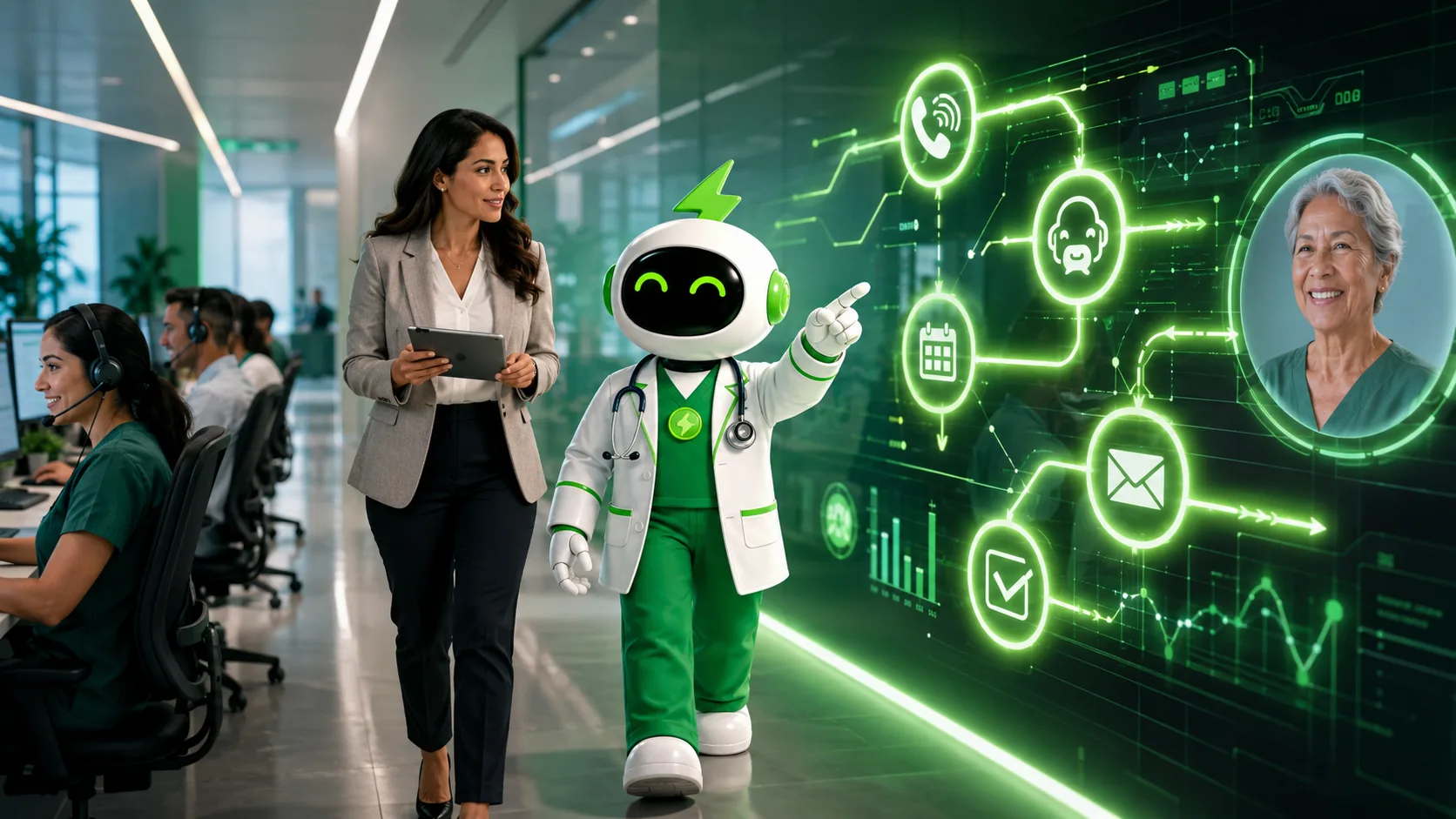
The medical call center is, in most Colombian clinics and hospitals, one of the largest operational cost centers and, at the same time, one of the least monetized. Tens of millions of pesos a month invested in agents who spend most of their day making mass reminders, confirming appointments and manually rescheduling cancellations. When this center is reorganized with intelligent IVR, voicebot and AI-connected scheduling, productivity per agent can multiply and the access cost per attended slot drops structurally. The difference between operating the old way and operating with modern automation is measured in hundreds of millions of pesos per year.
The saturated medical call center is the symptom; poor architecture is the cause
In Colombian operations of medium complexity, the medical call center usually has four to eight agents who dedicate between 60% and 75% of their time to repetitive tasks: telephone reminders, attendance confirmation, rescheduling after cancellations and calls to waiting lists to fill freed-up slots. The rest of the time goes to exception handling, complex patients and complaint resolution.
The problem is not that the team is not trained or does not work hard. The problem is structural: the team is doing manually what a good automated system should resolve. Adding more agents does not scale because each new agent brings the same productivity ceiling per hour. The only sustainable path is to change the architecture: the repetitive is automated, the human is concentrated on high value.
This reorganization is built on three complementary technologies that many clinics evaluate separately but that only work well when they work together: intelligent IVR, voicebot and integration with AI-based scheduling.
Intelligent IVR vs. traditional IVR: the real difference
The IVR (Interactive Voice Response) has been in use for decades. The menu "press 1 for appointments, press 2 for lab results, press 3 to contact the call center" is the classic version. Functional, but poor: it does not understand natural language, does not remember the patient, does not connect with the scheduling system and, in practice, frustrates the patient, who ends up asking for a human agent for any non-trivial query.
Intelligent IVR is another matter. Three characteristics distinguish it from the traditional one:
- Natural language recognition. The patient can say "I need to schedule an appointment with the gynecologist for next week" instead of navigating numbered options. The system understands, validates availability and schedules directly.
- Native connection with the scheduling system. The IVR does not just receive the request: it processes it against the schedule in real time, identifies available slots compatible with the patient's request and offers them. There is no intermediate human step for standard tasks.
- Memory of previous interactions. The patient who called two weeks ago does not have to repeat all their data. The system recognizes them by phone number, retrieves their context and offers care directly based on their recent history.
The operational difference between traditional IVR and intelligent IVR is measured in two indicators: the percentage of requests resolved without human agent intervention (which rises from 20%-30% to 70%-80%) and patient satisfaction in the interaction (which rises significantly because the system responds to the real request, not to a generic menu).
Voicebot: automated voice care with conversational AI
The voicebot is the next layer of automation. Unlike the IVR, which responds to patient inputs, the voicebot initiates outbound conversations. It makes calls to patients (to confirm appointments, remind them of follow-ups, offer freed-up slots) and maintains a natural conversation with whoever answers, identifying the response and escalating to the human agent only when necessary.
For clinics with volumes above 2,000 appointments per month, the voicebot is the only way to sustain the volume of confirmations without hiring additional staff. A human agent makes, on average, between 60 and 100 confirmations per day. A well-implemented voicebot makes hundreds of simultaneous calls, identifies responses in real time and escalates only the exceptions to the human.
The operational effects are substantial. In an operation that requires 800 daily confirmations, the voicebot can absorb 80%-90% of the volume, freeing the human team to concentrate on complex patients, first consultations and exception handling. Productivity per human agent multiplies precisely because gross volume stops being their responsibility.
Integration with AI-based scheduling: where the cycle closes
Intelligent IVR and voicebot are powerful tools, but their impact multiplies when they connect with an intelligent scheduling system that produces real-time information about each appointment. The connection adds two additional capabilities:
- Prioritization of calls according to risk score. The voicebot does not call at random: the scheduling system tells it which patients have a higher probability of a no-show and need focused confirmation. The voicebot prioritizes those calls, which maximizes the impact of the automated volume.
- Coordinated automatic rescue. When a patient cancels during a voicebot call, the system immediately triggers the automatic rescue of the slot, offering it to patients on the waiting list without going through the call center. What in a traditional operation would have taken hours of manual work happens in minutes with no human intervention.
This native integration between IVR, voicebot and AI scheduling is what we at COCO position as one of the core differentiators of the product, aligned with the CEO's sixth strategic differentiator: increasing call center productivity by connecting natively with existing or new IVR and voicebot systems, without requiring custom developments that take months.
Access cost reduction above 80%: the metric that changes the conversation
When these three technologies work together, the result is not incremental. The clinics that have brought intelligent IVR, voicebot and AI scheduling to production together with COCO report reductions in the access cost per attended slot of more than 80%.
The figure stops being surprising when it is broken down into its parts:
- Intelligent IVR resolves 70%-80% of incoming requests without human intervention, freeing the equivalent of three or four agents in a medium-sized operation.
- The voicebot absorbs 80%-90% of outbound calls, eliminating almost all the cost associated with mass confirmations and reminders.
- Integration with AI-based scheduling eliminates manual rescheduling, which in traditional operations usually consumes 20%-30% of the human team's time.
Each piece on its own seems marginal; together, they change the cost structure of the care front end. The human call center team stops being a volume-management center and becomes an exception-management center, which completely changes the economics of the operation.
An applied scenario: a call center with four agents and 2,500 monthly appointments
Let's take a Colombian clinic with 2,500 monthly appointments and four call center agents dedicated to confirmations, reminders and rescheduling. Three indicators before and after implementing intelligent IVR, voicebot and AI scheduling:
- Monthly call center cost: drops from approximately $25 million to $10-12 million pesos by reducing the human team needed for mass confirmations and shifting productivity toward exception handling.
- Productivity per remaining human agent: doubles by concentrating the agent's time on high-value interactions instead of volume.
- Access cost per attended slot: drops around 75%, mainly due to volume automation and the elimination of manual rescheduling.
In consolidated annual figures, this institution recovers between $150 and $200 million pesos from the call center reorganization alone, not counting the effect on no-show reduction or on better patient experience. It is the order of magnitude we see at COCO when the three layers operate integrated and not as loose systems connected by hand.
Frequently asked questions
Are IVR and intelligent IVR the same thing?
No. Traditional IVR operates with numeric menus and predefined routines. Intelligent IVR understands natural language, connects with the scheduling system in real time and resolves complex requests without human intervention. The operational difference is measured in the percentage of requests the system resolves on its own: 20%-30% in traditional IVR, 70%-80% in well-implemented intelligent IVR.
Does the voicebot replace the human agents of the call center?
No. It replaces the repetitive volume (mass confirmations, reminders, standard calls) and frees the human agents to concentrate on high-value interactions: complex patients, first consultations, complaint handling, operational exceptions. The human staff is not reduced to zero; it is reorganized with much higher productivity per agent.
What technical requirements does integration with existing IVR and voicebot have?
A serious platform must offer native integration with the main IVR and voicebot systems on the market, without requiring custom developments that take months. The right question when evaluating providers is: with how many IVR/voicebot platforms do you have integration proven in production? If the answer is vague, there is probably custom development ahead.
How long does it take to see results in call center productivity?
The effects of intelligent IVR are visible from the first week because it operates on incoming requests immediately. The voicebot requires between two and four weeks to calibrate response rates. The consolidated reduction of the call center cost is clearly measured between day 60 and day 90 of stable operation.
Increasing medical call center productivity is not a conversation about training the team better or adding agents. It is a conversation about technological architecture: intelligent IVR to resolve inbound, voicebot to automate outbound and AI scheduling to coordinate the entire cycle. At COCO we position this integration as one of the core differentiators of the product. If you want to see how the economics of your institution's call center would change with this architecture, schedule a conversation with the team and let's review the data together through a demo of intelligent scheduling with IVR.
What problem does How to increase medical call center productivity with IVR, voicebot and artificial intelligence address?
How can it be applied in a clinic, hospital, or healthcare provider?
Which indicators should healthcare leaders track?
Do you want to optimize medical scheduling?
See how COCO helps automate access, confirm appointments, and reduce operational workload.
COCO in the press
What independent media have published on this topic.
- El TiempoClinics and hospitals grew appointment management over 24% using AI
- Diario ADNIn Colombia, under 50% of hospitals offer digital scheduling and results
- InfobaeHow AI and automation will transform clinics and hospitals in 2026
- Noticias RCNTrends that will transform clinics and hospitals in 2026
Related articles

Medical Scheduling Software for Latin American Clinics
What medical scheduling software should solve when a clinic needs to connect access, availability, and care flow.
AI Referral and Authorization Automation for Healthcare Providers
A practical guide to automating referrals, orders and authorizations with AI while preserving traceability for healthcare providers.
FHIR and HL7 Interoperability in Colombia: A Practical Guide for Clinics
How to prepare data, processes and teams to connect electronic records, scheduling and operations through interoperability standards.