Automating Authorizations and Patient Follow-Up in Hospitals
Two specific chains: getting an authorization through, and following the patient afterwards without manual rework.
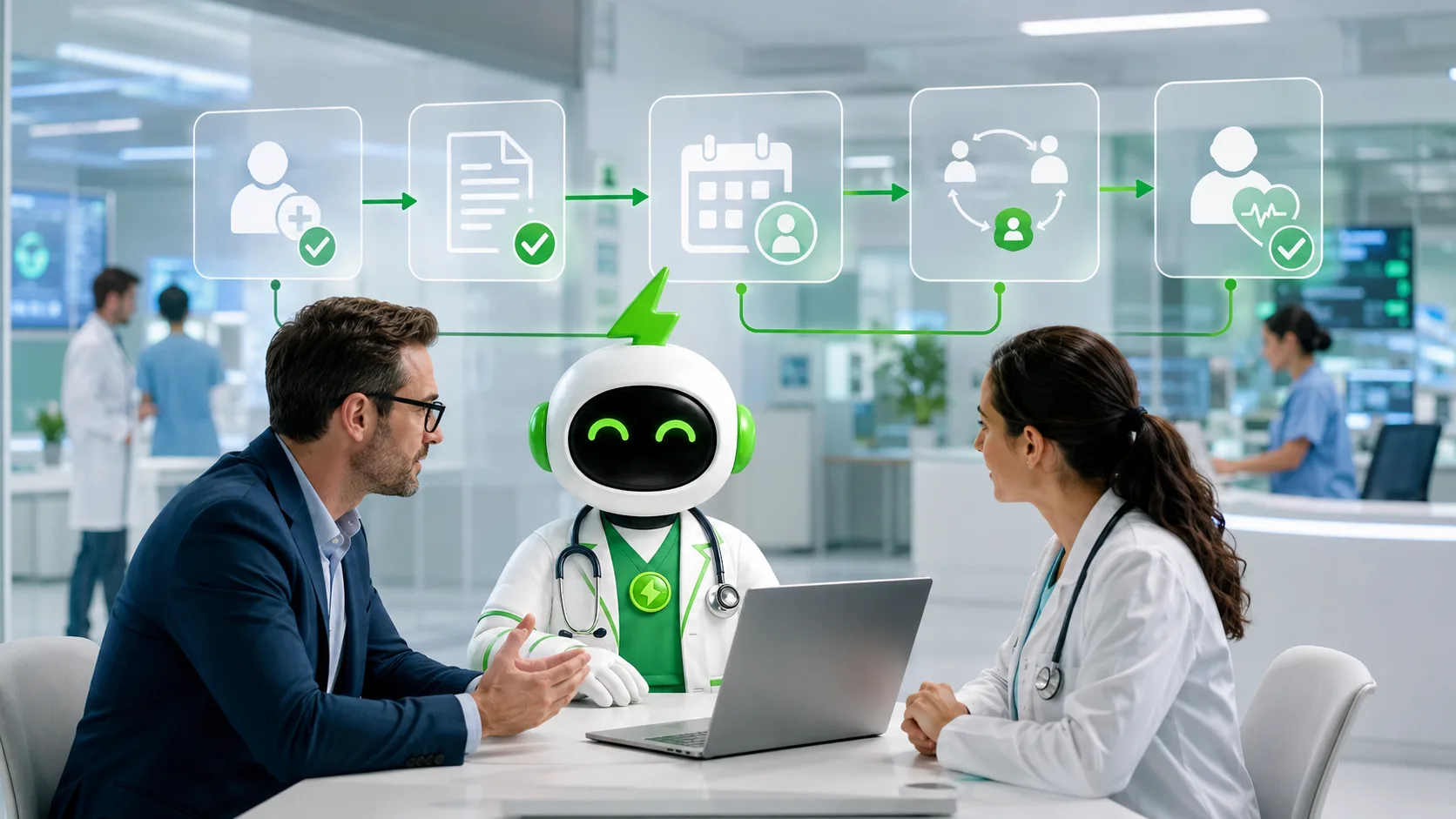
In a clinic or hospital, many delays do not happen during the consultation. They happen earlier: an authorization is not validated, an order arrives through another channel, a document sits in an unclassified inbox or a patient does not receive clear instructions.
Automating hospital processes with AI means coordinating those tasks through rules, data and human oversight. It is not about handing clinical decisions to a robot; it is about reducing repetitive work so teams can focus on cases that require attention.
The journey to automate first
The most valuable workflow is usually the one with high volume, relatively clear rules and significant rework. For a healthcare provider, it may start with a medical order received through WhatsApp, email or a form and end with a confirmed appointment or a request for missing information.
- Intake: record channel, patient, service and date.
- Classification: identify order, authorization, referral or support document.
- Reading: extract relevant document data and detect missing fields.
- Validation: compare information against institutional rules.
- Action: schedule, request correction, escalate or close the case.
- Follow-up: inform the patient and keep the status visible to the team.
Why interoperability matters
When every system owns one part of the record, automation can create another silo. The institution should define the official source for each data point, which events must synchronize and how traceability is preserved.
The HL7 FHIR standard provides a framework for exchanging health information through well-defined resources and APIs. Not every organization needs a full FHIR implementation on day one, but integrations should use clear identifiers, states and responsibilities.
High-impact use cases
- Authorizations: detect expirations, missing data and next steps.
- Referrals: classify the requested service and route it correctly.
- Medical orders: read data, validate consistency and associate the document with the patient.
- Procedure preparation: send instructions and alert teams when confirmation is missing.
- Follow-up: trigger messages by state, date and patient response.
- Internal management: distribute tasks and measure resolution time.
The importance of human-in-the-loop
In healthcare, safe automation must know when to stop. If a document is unreadable, data conflicts or a case does not meet a rule, the system should escalate it to a person with the right context. The goal is not to eliminate every review, but to reserve review for the exceptions that matter.
PAHO/WHO highlights the need for ethical, secure and interoperable digital transformation in Colombia. That guidance is useful when designing workflows where speed is balanced with privacy, consent and accountability.
How COCO can participate
COCO Tech AI can act as an orchestration layer between patient intake and institutional systems. Its medical scheduling, communication, clinical OCR, queue management and analytics capabilities can connect events that are often managed separately.
- Multichannel intake with identification and traceability.
- Clinical OCR for orders, referrals and support documents.
- Rules for completing or escalating cases.
- Scheduling and rescheduling connected to communication.
- Status, time and owner tracking.
- Reporting to identify rework and leakage points.
A minimum architecture to start
A first implementation can be defined with six components: a case identifier, a state catalog, business rules, an exception queue, an event log and an indicator dashboard. This foundation allows the program to grow without turning automation into a black box.
- Case: which patient and service are being managed.
- State: received, validating, pending, scheduled, escalated or closed.
- Event: what happened, when and through which channel.
- Owner: which team must act.
- Evidence: associated document, reply or authorization.
- Indicator: how long it took and what the outcome was.
Indicators that demonstrate return
- Average time from intake to resolution.
- Percentage of documents processed without manual data entry.
- Cases returned for incomplete information.
- Patient response time.
- Appointments generated from incoming requests.
- Percentage of exceptions escalated correctly.
Hospital automation works when teams can explain what improved and why. A dashboard showing less rework, faster response and better traceability is more useful than an abstract promise of artificial intelligence.
Frequently asked questions
Which hospital processes should be automated first?
Can AI approve a medical authorization?
What does COCO add to hospital automation?
Conclusion
AI hospital process automation is most valuable when it starts with one concrete workflow and is designed around states, exceptions and owners. This allows clinics, hospitals and healthcare providers to move toward operations that are faster, more integrated and verifiable.
Do you want to optimize medical scheduling?
See how COCO helps automate access, confirm appointments, and reduce operational workload.
COCO in the press
What independent media have published on this topic.
Related articles
Medical Scheduling Software for Latin American Clinics
What medical scheduling software should solve when a clinic needs to connect access, availability, and care flow.
AI Referral and Authorization Automation for Healthcare Providers
A practical guide to automating referrals, orders and authorizations with AI while preserving traceability for healthcare providers.
FHIR and HL7 Interoperability in Colombia: A Practical Guide for Clinics
How to prepare data, processes and teams to connect electronic records, scheduling and operations through interoperability standards.