Clinical OCR for medical records: how to turn documents into operational decisions
Clinical OCR turns PDFs, images, medical orders and authorizations into useful data to reduce manual validation and accelerate scheduling.
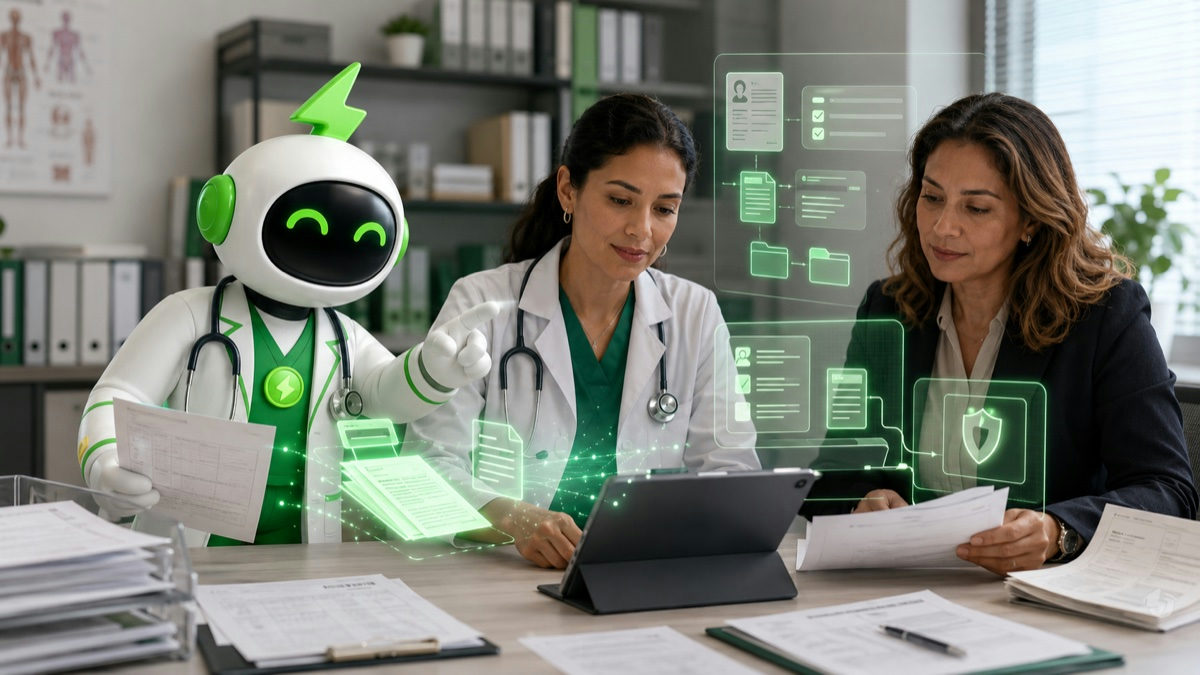
Digitizing a medical record is not the same as scanning a document. It means turning scattered information into data that helps the clinic operate better, validate faster and decide what should happen next.
In healthcare, many processes stop because PDFs, images, medical orders, authorizations and results need to be reviewed manually. That step consumes time, overloads the call center and delays patient access.
Why generic OCR is not enough for healthcare
Generic OCR can read text. A clinic needs more than that. It needs to know whether the document belongs to the patient, whether the order is still valid, whether the requested service matches and whether the case can move to scheduling.
- Read PDFs, images and scanned documents.
- Extract relevant clinical and administrative data.
- Validate identity, validity, payer, requested service and codes.
- Decide whether the process can continue without manual intervention.
Clinical NLP advances, including the resources described in ClinText-SP and RigoBERTa Clinical, show why healthcare context requires more specialized models and rules than generic text reading. In clinical operations, reading is not enough: data must become a reliable action.
The challenge of clinical documents in LATAM
Clinical documents include abbreviations, local formats, service names, codes, stamps, scanned orders and institutional variations. Clinical digitization must adapt to the real operating context in LATAM.
The goal is not just to “extract text”. The goal is to reduce errors, accelerate validations and allow the patient to move forward without depending on a phone call.
How COCO clinical OCR software works
COCO reads documents in multiple formats, extracts relevant data, validates operational rules and decides whether the appointment can be scheduled automatically with support from clinical OCR software.
- Reads images and PDFs sent by the patient.
- Extracts data required for the care flow.
- Validates expiration date, payer, service, identity and applicable codes.
- Connects document reading with medical scheduling software.
What the institution gains
When document validation stops being fully manual, the team gains time and the institution reduces friction.
- Fewer calls to confirm data already included in documents.
- Fewer data-entry errors.
- More patient self-service.
- Better use of installed capacity.
- More traceability for audit, follow-up and data quality.
Reviews of NLP in electronic health records and healthcare decision-making and frameworks for clinical EHR data quality reinforce a practical point: automation is valuable only when it improves data reliability and reduces manual steps without losing traceability.
Clinical OCR + scheduling: the key difference
Automation becomes valuable when OCR does not end in a review tray. It ends in an action: schedule, ask for correction, request a missing document or escalate the case.
That is the difference between scanning documents and automating clinical operations. The flow can connect with patient engagement campaigns, scheduling and the telemedicine platform to reduce patient friction.
FAQ
Does clinical OCR replace administrative teams?
No. It reduces repetitive work and keeps teams focused on complex cases, audit and exceptions.
What documents can it process?
Medical orders, authorizations, results, images, PDFs and documents related to validation and scheduling workflows.
Why does local clinical context matter?
Because clinical documents have their own language, formats, codes and operational rules. Context matters to validate data and make the right decision.
Conclusion
Clinical OCR should not stop at reading documents. It should help make decisions. COCO turns clinical documents into clear operational steps to reduce friction, accelerate scheduling and improve the patient experience.
What problem does Clinical OCR for medical records: how to turn documents into operational decisions address?
How can it be applied in a clinic, hospital, or healthcare provider?
Which indicators should healthcare leaders track?
Do you want to turn clinical documents into useful data?
See how COCO transforms healthcare documents into actionable information for your organization.
COCO in the press
What independent media have published on this topic.
- El TiempoClinics and hospitals grew appointment management over 24% using AI
- Diario ADNIn Colombia, under 50% of hospitals offer digital scheduling and results
- InfobaeHow AI and automation will transform clinics and hospitals in 2026
- Noticias RCNTrends that will transform clinics and hospitals in 2026
Related articles
Medical Scheduling Software for Latin American Clinics
What medical scheduling software should solve when a clinic needs to connect access, availability, and care flow.
AI Referral and Authorization Automation for Healthcare Providers
A practical guide to automating referrals, orders and authorizations with AI while preserving traceability for healthcare providers.
FHIR and HL7 Interoperability in Colombia: A Practical Guide for Clinics
How to prepare data, processes and teams to connect electronic records, scheduling and operations through interoperability standards.